Liquid fertiliser is a not a new technology, but it is now on an upward trajectory in application rates all around the country for both arable and grassland farms.
According to Luke Thornton the sales manager for OMEX Ireland, any conventional farm sprayer made over the last 30 years can easily be modified to apply liquid fertiliser.
“It is possible to modify a farm sprayer once the nozzles are changed from fan based which are mainly used on farms to apply herbicides, fungicides and pesticides to a dribble type
nozzle.
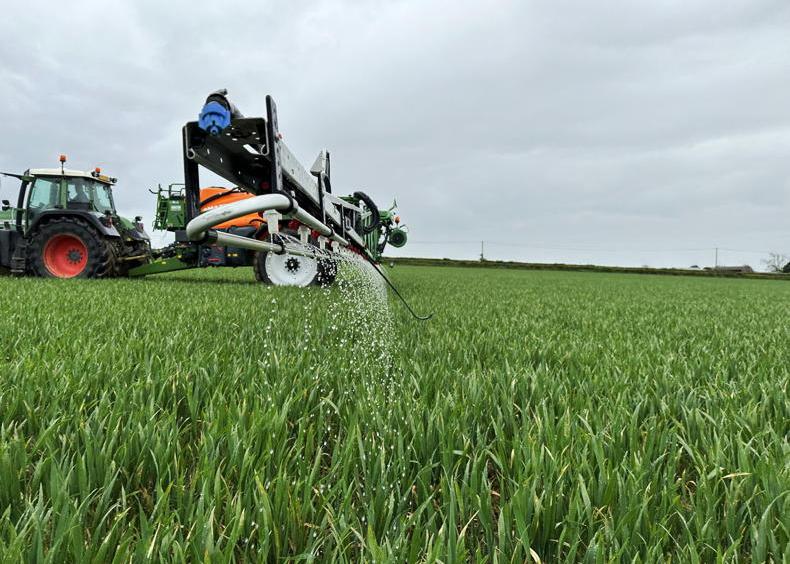
“Liquid fertiliser nozzles differ as they create large droplets or solid streams; you then reduce your pressure to around 1 bar or slightly above and you’re ready to apply.
“We see a lot of our customers fitting the Teejet SJ-7 series brand of nozzles, and they are getting very good results but there are many other makes of nozzles that also produce course low drift droplets or solid streams to suit liquid fertiliser.”
OMEX first entered the Irish market back in 2016 and Luke says it was initially the 600-700 acre plus tillage farmer who was converting but, due to a host of other reasons, they are getting much more interest across Ireland now.
“Fertiliser prices were certainly a factor in farmers looking at alternatives, but accuracy, fast uptake and the three forms of nitrogen within this liquid N product are other keys reasons.”
To accommodate this market growth in Spring 2024, OMEX opened Ireland’s first dedicated liquid fertiliser terminal at Ringaskiddy in Co Cork where they now accommodate bulk shipments and then distribute to Irish farmers via road tankers. They also have a growing distributor network throughout Ireland to sell IBC tanks to farmers.
Calibration and application rates
Like any farm implement, for a sprayer to perform to its optimum it must be set up correctly and used appropriately.
The main thing with nozzles is to check the manufacturer’s flowrate charts or ask for advice initially. Teejet, for example, uses a colour code system to help visually identify nozzle flow rates and hence product application rate. Once a farmer knows boom width, nozzle spacing and targeted forward speed, it’s very easy to calculate the application rate.
Liquid fertiliser is applied as L/ha as all sprayers work in this way. As an example, 245L/ha of Nitroflo 24N+3S delivers the equivalent of 60 units N/ac.
“We provide simple conversion tables to work out application rates with ease. If, for example, a farmer wanted to apply 60 units of nitrogen at 10KPH, our customers are having great success with Teejets white 08 nozzle or if they wanted to apply 30 units of N at 10KPH, it’s the Red 04 nozzle with the sprayer set at between one-two bar pressure.”
You don’t want small droplets like a mist, but large course droplets or streams so it penetrates down to the soil, and the product is then absorbed up by the roots.
Modern sprayers have automatic volume regulators, multi nozzle adapters and much more besides to make sure application is consistent and accurate.
Luke says a farmer can apply nearly any day during the allocated DAFM timeframe for inorganic fertiliser. “What we advise our customers is if there is a heavy dew in the morning and their boots are wet when walking through the field then wait two to three hours and let the grass dry for maximum effect.”
Tillage farmers are often well versed in spraying equipment and have a tradition of being forward thinking in cropping systems and fertilisation. A lot of tillage farmers also have the added advantage of owning a decent sprayer so adapting to liquid fertiliser isn’t as big a venture.
Luke sees contractors as the future for liquid fertiliser on grassland farms here in Ireland and “we are getting an awful lot of enquires from them over the last two years”.
They are becoming more aware of the opportunities of offering liquid fertiliser application as a service both on tillage and grassland farms.
Contractors are key in what would have been considered the traditional grass-based parts of the country, as this means farmers don’t have to make any sudden investments in their current system if they don’t want to. If dairy farmers have scale, of course they can justify purchasing equipment, then they can apply it themselves no problem.
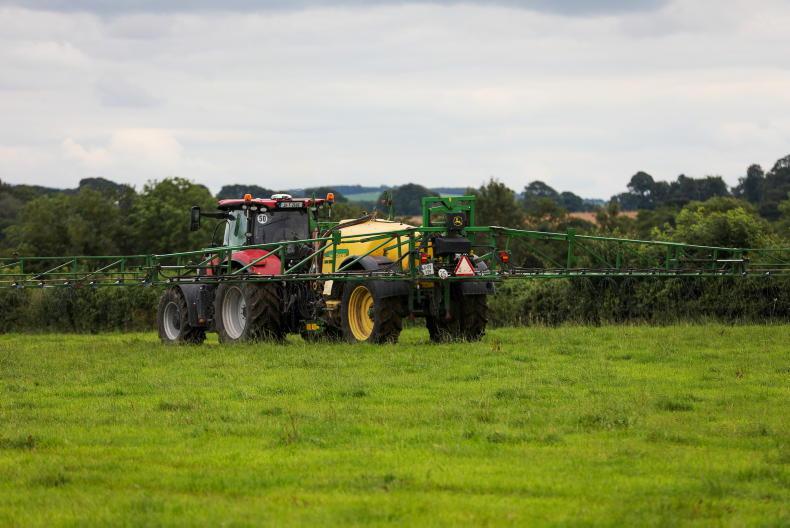
Like with granular spreaders, sprayers that have the latest technology like section control, GPS, ISOBus and variable rate all help aid in achieving further efficiency gains and maximising crop yields.
“If you don’t have a sprayer on your farm, we have an range of contractors operating across Ireland who can apply the product similar to a granular spreading service,” Luke adds.
The product is comprised of Urea Ammonium Nitrate (UAN) plus Ammonium Sulphate (AS) so three different forms of N are available to the plant.
It is readily available and works immediately and less prone to volatilisation.
OMEX’s products works through the soil and not the leaf like a foliar type of fertiliser. It is a direct replacement for granular products such as CAN or protected Urea and is sold per tonne the same as granular fertiliser.
Like any product soil type, soil health and PH plus a host of other factors need to be considered to get maximum gains.
Potential benefits on a grassland system
Get back to the next cut of silage quicker. Luke says you can follow the harvester or baler in a silage scenario with an application of liquid nitrogen and apply slurry the following day. This greatly increases efficiency as the general rule in a granular system is slurry first and granular application 7-10 days later depending on conditions. Liquid gives top-quality grass and a better quantity, often getting the next cut done a week earlier than a granular system. Three forms of nitrogen. As the product is comprised of UAN, it delivers three forms of N for the plant to utilise. This then ensures a staged release to the plant.As it is a liquid, it doesn’t have to go through the process of breaking down like granules do, resulting in better uptake, particularly in drier periods. Every blade of grass within the field margin gets the same nutrition, giving better consistency in both grazing and silage scenarios. Flexibility of application. Luke is adamant there are more application days than a granular spreader. It can be applied in dry, damp and windy conditions. The only time you can’t apply liquid fertiliser is to a wet crop that is drying rapidly, eg a silage crop in March on a sunny, windy morning. Once the plant is dry on this type of day, application is safe. Nothing goes in the ditch or the waterways, meaning less of a weed burden and a better environmental profile.Fewer ammonia emissions with NitroShield. This is a urease inhibitor and can be added to the sprayer at point of use at a 1000:1 ratio. It fully protects the urea element of the fertiliser in extremely dry or high-risk periods. It differs from granular protected urea, where the granule is coated with an inhibitor and the efficiency changes over time. Similar pricing point to granular and sometimes cheaper depending on product.Clean storage – no plastic bags, no solid lumps to break up, blocking of outlets, making dust of granular and poor spreading widths or farm loader needed. Liquid nitrogen is also suitable for use incorporated into the seedbed in the likes of beet, maize and spring cereals. OMEX currently has two tank options for farmers here; a 30m3 and 50m3 capacity.
The 30m3 tank holds one full 30-ton load of liquid fertiliser which would be like a full load of CAN and the 50m3 tank holds two full loads of liquid fertiliser. According to Luke, they will install these on farms at no cost subject to a fully bunded area being provided and a minimum throughput per year of two loads of 50m3 tank or four loads of 30m3.
Alternatively, farmers with lower fertiliser demands can purchase IBCs and use these accordingly from their nearest nationwide distributors.
Sprayer maintenance and hygiene
Regarding sprayer maintenance and hygiene, the machinery requires a standard rinse with a high-volume hose like a volume washer on dairy farms post application (no need for a pressure washer) and a few hundred litres of water washed through the pump.
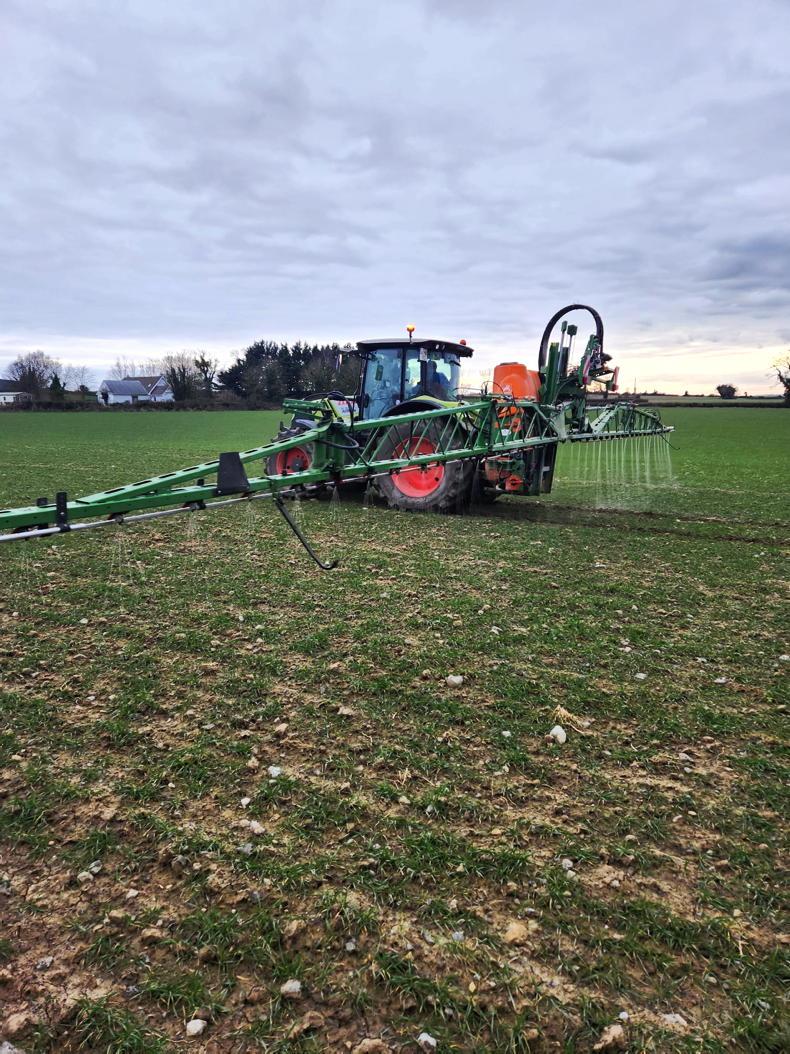
Luke says sprayers do not age any quicker when using liquid fertiliser once a strict wash-down regime is adhered to and the machine manufacturers own maintenance procedure is followed in terms of oil, grease and filters.
The machine should be then flushed thoroughly internally with water and there is no issues with pumps or seals if cleaned properly.
Robert Tobin is dairy farming outside Arklow, Co Wicklow on a 300-acre parcel of land, he has moved from granular to liquid for his nitrogen application.
“I moved to liquid N about four years ago when the price of granular skyrocketed and I haven’t looked back.
“In the summertime if there is no rain forecast, I can still go out and apply liquid N and it’s plant available immediately and not sitting on top of the ground losing ammonia to the atmosphere but it’s getting to work straight away and growing grass.
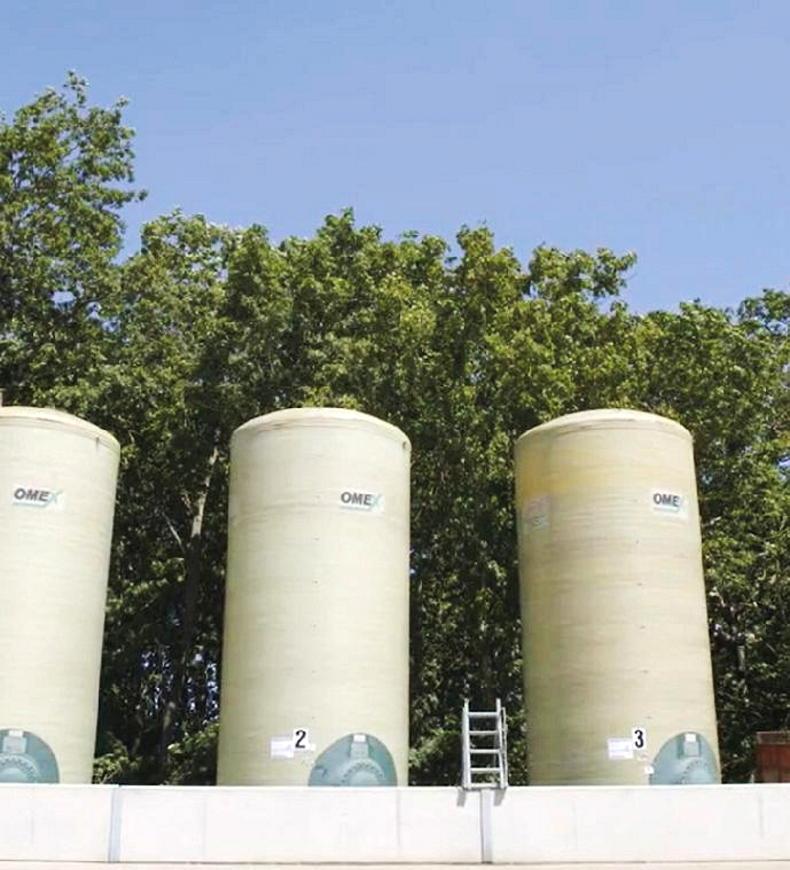
OMEX tanks are supplied free to farmers under certain conditions
“I currently hire in a contractor to apply it and there is no messing as there is no loading machinery needed, or having bags and rubbish to deal with, the sprayer just sucks it out of the IBCs.”
Robert initially applied like for like with the quantities he used to apply with granular on his farm, but he states he probably grew about 10% more grass.
“Today I’m applying 10% less but growing the same as when I applied granular so that’s a saving also.
“I love the fact that it’s fast acting, no wastage, no skips, it’s very evenly applied and I’m not worried about rain having to wash it in.”
Liquid fertiliser is a not a new technology, but it is now on an upward trajectory in application rates all around the country for both arable and grassland farms.
According to Luke Thornton the sales manager for OMEX Ireland, any conventional farm sprayer made over the last 30 years can easily be modified to apply liquid fertiliser.
“It is possible to modify a farm sprayer once the nozzles are changed from fan based which are mainly used on farms to apply herbicides, fungicides and pesticides to a dribble type
nozzle.
“Liquid fertiliser nozzles differ as they create large droplets or solid streams; you then reduce your pressure to around 1 bar or slightly above and you’re ready to apply.
“We see a lot of our customers fitting the Teejet SJ-7 series brand of nozzles, and they are getting very good results but there are many other makes of nozzles that also produce course low drift droplets or solid streams to suit liquid fertiliser.”
OMEX first entered the Irish market back in 2016 and Luke says it was initially the 600-700 acre plus tillage farmer who was converting but, due to a host of other reasons, they are getting much more interest across Ireland now.
“Fertiliser prices were certainly a factor in farmers looking at alternatives, but accuracy, fast uptake and the three forms of nitrogen within this liquid N product are other keys reasons.”
To accommodate this market growth in Spring 2024, OMEX opened Ireland’s first dedicated liquid fertiliser terminal at Ringaskiddy in Co Cork where they now accommodate bulk shipments and then distribute to Irish farmers via road tankers. They also have a growing distributor network throughout Ireland to sell IBC tanks to farmers.
Calibration and application rates
Like any farm implement, for a sprayer to perform to its optimum it must be set up correctly and used appropriately.
The main thing with nozzles is to check the manufacturer’s flowrate charts or ask for advice initially. Teejet, for example, uses a colour code system to help visually identify nozzle flow rates and hence product application rate. Once a farmer knows boom width, nozzle spacing and targeted forward speed, it’s very easy to calculate the application rate.
Liquid fertiliser is applied as L/ha as all sprayers work in this way. As an example, 245L/ha of Nitroflo 24N+3S delivers the equivalent of 60 units N/ac.
“We provide simple conversion tables to work out application rates with ease. If, for example, a farmer wanted to apply 60 units of nitrogen at 10KPH, our customers are having great success with Teejets white 08 nozzle or if they wanted to apply 30 units of N at 10KPH, it’s the Red 04 nozzle with the sprayer set at between one-two bar pressure.”
You don’t want small droplets like a mist, but large course droplets or streams so it penetrates down to the soil, and the product is then absorbed up by the roots.
Modern sprayers have automatic volume regulators, multi nozzle adapters and much more besides to make sure application is consistent and accurate.
Luke says a farmer can apply nearly any day during the allocated DAFM timeframe for inorganic fertiliser. “What we advise our customers is if there is a heavy dew in the morning and their boots are wet when walking through the field then wait two to three hours and let the grass dry for maximum effect.”
Tillage farmers are often well versed in spraying equipment and have a tradition of being forward thinking in cropping systems and fertilisation. A lot of tillage farmers also have the added advantage of owning a decent sprayer so adapting to liquid fertiliser isn’t as big a venture.
Luke sees contractors as the future for liquid fertiliser on grassland farms here in Ireland and “we are getting an awful lot of enquires from them over the last two years”.
They are becoming more aware of the opportunities of offering liquid fertiliser application as a service both on tillage and grassland farms.
Contractors are key in what would have been considered the traditional grass-based parts of the country, as this means farmers don’t have to make any sudden investments in their current system if they don’t want to. If dairy farmers have scale, of course they can justify purchasing equipment, then they can apply it themselves no problem.
Like with granular spreaders, sprayers that have the latest technology like section control, GPS, ISOBus and variable rate all help aid in achieving further efficiency gains and maximising crop yields.
“If you don’t have a sprayer on your farm, we have an range of contractors operating across Ireland who can apply the product similar to a granular spreading service,” Luke adds.
The product is comprised of Urea Ammonium Nitrate (UAN) plus Ammonium Sulphate (AS) so three different forms of N are available to the plant.
It is readily available and works immediately and less prone to volatilisation.
OMEX’s products works through the soil and not the leaf like a foliar type of fertiliser. It is a direct replacement for granular products such as CAN or protected Urea and is sold per tonne the same as granular fertiliser.
Like any product soil type, soil health and PH plus a host of other factors need to be considered to get maximum gains.
Potential benefits on a grassland system
Get back to the next cut of silage quicker. Luke says you can follow the harvester or baler in a silage scenario with an application of liquid nitrogen and apply slurry the following day. This greatly increases efficiency as the general rule in a granular system is slurry first and granular application 7-10 days later depending on conditions. Liquid gives top-quality grass and a better quantity, often getting the next cut done a week earlier than a granular system. Three forms of nitrogen. As the product is comprised of UAN, it delivers three forms of N for the plant to utilise. This then ensures a staged release to the plant.As it is a liquid, it doesn’t have to go through the process of breaking down like granules do, resulting in better uptake, particularly in drier periods. Every blade of grass within the field margin gets the same nutrition, giving better consistency in both grazing and silage scenarios. Flexibility of application. Luke is adamant there are more application days than a granular spreader. It can be applied in dry, damp and windy conditions. The only time you can’t apply liquid fertiliser is to a wet crop that is drying rapidly, eg a silage crop in March on a sunny, windy morning. Once the plant is dry on this type of day, application is safe. Nothing goes in the ditch or the waterways, meaning less of a weed burden and a better environmental profile.Fewer ammonia emissions with NitroShield. This is a urease inhibitor and can be added to the sprayer at point of use at a 1000:1 ratio. It fully protects the urea element of the fertiliser in extremely dry or high-risk periods. It differs from granular protected urea, where the granule is coated with an inhibitor and the efficiency changes over time. Similar pricing point to granular and sometimes cheaper depending on product.Clean storage – no plastic bags, no solid lumps to break up, blocking of outlets, making dust of granular and poor spreading widths or farm loader needed. Liquid nitrogen is also suitable for use incorporated into the seedbed in the likes of beet, maize and spring cereals. OMEX currently has two tank options for farmers here; a 30m3 and 50m3 capacity.
The 30m3 tank holds one full 30-ton load of liquid fertiliser which would be like a full load of CAN and the 50m3 tank holds two full loads of liquid fertiliser. According to Luke, they will install these on farms at no cost subject to a fully bunded area being provided and a minimum throughput per year of two loads of 50m3 tank or four loads of 30m3.
Alternatively, farmers with lower fertiliser demands can purchase IBCs and use these accordingly from their nearest nationwide distributors.
Sprayer maintenance and hygiene
Regarding sprayer maintenance and hygiene, the machinery requires a standard rinse with a high-volume hose like a volume washer on dairy farms post application (no need for a pressure washer) and a few hundred litres of water washed through the pump.
Luke says sprayers do not age any quicker when using liquid fertiliser once a strict wash-down regime is adhered to and the machine manufacturers own maintenance procedure is followed in terms of oil, grease and filters.
The machine should be then flushed thoroughly internally with water and there is no issues with pumps or seals if cleaned properly.
Robert Tobin is dairy farming outside Arklow, Co Wicklow on a 300-acre parcel of land, he has moved from granular to liquid for his nitrogen application.
“I moved to liquid N about four years ago when the price of granular skyrocketed and I haven’t looked back.
“In the summertime if there is no rain forecast, I can still go out and apply liquid N and it’s plant available immediately and not sitting on top of the ground losing ammonia to the atmosphere but it’s getting to work straight away and growing grass.
OMEX tanks are supplied free to farmers under certain conditions
“I currently hire in a contractor to apply it and there is no messing as there is no loading machinery needed, or having bags and rubbish to deal with, the sprayer just sucks it out of the IBCs.”
Robert initially applied like for like with the quantities he used to apply with granular on his farm, but he states he probably grew about 10% more grass.
“Today I’m applying 10% less but growing the same as when I applied granular so that’s a saving also.
“I love the fact that it’s fast acting, no wastage, no skips, it’s very evenly applied and I’m not worried about rain having to wash it in.”









SHARING OPTIONS